The 9 Best Midi Keyboards of 2026
Choosing the right midi keyboard can elevate your music production workflow. We tested 9 leading models from M-AUDIO, Akai Professional, Arturia and more in November 2026 to help you decide.
 By Chloe Bennett
Updated November 19, 2026
Choosing the right MIDI controller can feel overwhelming. You’re stuck balancing a tight budget, figuring out software compatibility, and trying to find the right keybed feel for your playing style. The most critical decisions come down to the number of keys you need for full compositions, the key action type that matches your playing technique, and the depth of DAW integration for a seamless workflow.

After reviewing the market, we find the M-AUDIO Keystation 49 MK3 USB MIDI Controller offers the best balance of features for most music producers. For those needing premium pads and deep DAW control, the Novation Launchkey 61 MK4 USB MIDI Keyboard is an excellent choice. For more insights into music gear, explore our related guides on musical instruments.
The 3 Best Midi Keyboards on Our Shortlist (November 2026)
- Best for: Balanced Workstation Control
- Keys: 49 Synth-Action
- DAW Control: Transport & Fader
- Software Suite: MPC Beats, Ableton Live

- Best for: Advanced DAW & Pad Workflow
- Keys: 61 Semi-Weighted
- Pads: 16 with Aftertouch
- Integration: NKS & Multi-DAW

- Best for: Compact Beat Making
- Keys: 25 Mini Velocity-Sensitive
- Pads: 8 MPC-Style
- Features: Thumbstick, Arpeggiator
This post may contain affiliate links. As an Amazon Associate we earn from qualifying purchases.
Quick Comparison
| Award | Product | TDB Score About LAT ScoreThe TDB Score is our own rating from 0 to 10, based on performance, design and build, ease of use, and value. It reflects independent research and is never influenced by manufacturers, retailers, or affiliate commissions. How we score | Price | |
|---|---|---|---|---|
| Best Overall |
M-Audio Keystation 49 MK3 USB MIDI Controller
|
9.2/10 | $129.00 | Buy |
| Best Premium |
Novation Launchkey 61 MK4 MIDI Controller
|
9.1/10 | $329.99 | Buy |
| Best Value |
 M-AUDIO Keystation 88 MK3 88-Key MIDI Controller |
8.9/10 | $299.00 | Buy |
| Top Rated |
 Arturia KeyLab Essential mk3 61-Key MIDI |
8.8/10 | $299.00 | Buy |
| Best Budget |
 Arturia MiniLab 3 25 Keys MIDI Controller |
8.6/10 | $116.03 | Buy |
| Also Great |
 Novation Launchkey Mini 25 MK4 MIDI Controller |
8.1/10 | $129.99 | Buy |
| Also Great |
 M-Audio Oxygen Pro 49 USB MIDI Keyboard |
8.1/10 | $299.00 | Buy |
| Also Great |
Akai MPK Mini MK3 25 Key MIDI Controller
|
7.8/10 | $89.00 | Buy |
| Also Great |
 Arturia KeyLab Essential mk3 49-Key MIDI |
7.8/10 | $229.00 | Buy |
M-Audio Keystation 49 MK3 USB MIDI Controller
This 49-key USB MIDI controller is aimed at producers and performers who want full-size velocity-sensitive keys in a compact desk setup. It includes pitch and modulation wheels, a volume fader, transport controls, and bundled software for Mac and PC, with iOS support through an adapter. The layout suits beginners and intermediate users who need a straightforward keyboard for software instruments rather than a large professional controller.
Pros
- 49 full-size velocity-sensitive keys provide a natural playing surface for software instruments.
- Pitch and modulation wheels plus a sustain pedal input support expressive performance.
- Volume fader, transport, and directional buttons help control recording software.
- USB connection works with Mac and PC without drivers or a power supply.
- Bundled MPC Beats, Ableton Live Lite, and other software gives a starting toolkit.
Cons
- The 49-key range can feel limiting for piano-style parts that need a wider span.
- iOS use requires a separately sold Apple to USB Camera Adapter.
- As a MIDI controller, it does not replace an audio interface or sound card.
Novation Launchkey 61 MK4 MIDI Controller
For producers and performers working across Ableton Live, Logic, Cubase, and other major DAWs, the Launchkey 61 MK4 offers a 61-key semi-weighted controller with 16 polyphonic aftertouch pads, 9 faders, pitch and mod wheels, and an OLED display. Its Scale and Chord modes, plus included software and sounds, are aimed at quick idea capture and live control.
Pros
- 61 semi-weighted keys with pitch and mod wheels for expressive keyboard control
- 16 FSR pads with polyphonic aftertouch support drumming, clip launching, and chord triggering
- Integrates with major DAWs including Ableton Live, Logic, Cubase, Reason, Reaper, FL Studio, and Ardour
- Includes Ableton Live Lite, Cubase LE, Novation Play, sounds, and free Melodics lessons
- Scale Mode and Chord modes help keep performances in key and trigger chords
Cons
- The 61-key layout and 10.5-pound weight may be less portable than smaller controllers
- At 35.2 inches wide, it needs more desk space than compact MIDI keyboards
- Polyphonic aftertouch is listed for the pads, not the keybed
M-AUDIO Keystation 88 MK3 88-Key MIDI Controller
This 88-key USB MIDI controller is built for producers who want a full piano feel without the bulk. Its plug-and-play design connects directly to a computer, and the bundle of production software makes it ready for immediate use.
Pros
- Full 88-key semi-weighted keyboard provides a realistic playing experience
- Plug-and-play USB connectivity requires no external power or drivers
- Includes a comprehensive suite of DAW and virtual instrument software
Cons
- Requires a separate adapter for use with iOS devices
- Semi-weighted keys may not satisfy players seeking a fully hammer-action feel
Arturia KeyLab Essential mk3 61-Key MIDI
This 61-key MIDI controller is designed for music production and performance, featuring extensive software integration and creative controls. It's a solid choice for producers and performers who want in-depth control over their DAW and virtual instruments.
Pros
- Comes with 2000 Analog Lab V software presets for immediate creative use
- Deep DAW integration and RGB-backlit pads for enhanced workflow
- Includes pitch and mod wheels, rotary encoders, and Scale/Chord/Arpeggiator modes
Cons
- Weighs nearly 7 pounds, making it less portable than some compact controllers
Arturia MiniLab 3 25 Keys MIDI Controller
Arturia's MiniLab 3 packs 25 velocity-sensitive keys, eight multicolor pads, and four faders into a 14 by 8.6 inch body. The compact size and light weight suit small workspaces, while the universal MIDI format and software package help connect it to music tools.
Pros
- Universal MIDI compatibility
- 25 velocity-sensitive keys
- Eight multicolor pads
- Four faders
- Compact 14 by 8.6 inch footprint
Cons
- 25 key size may limit extended range or two-handed playing
- Four faders and eight pads may not suit larger hardware control workflows
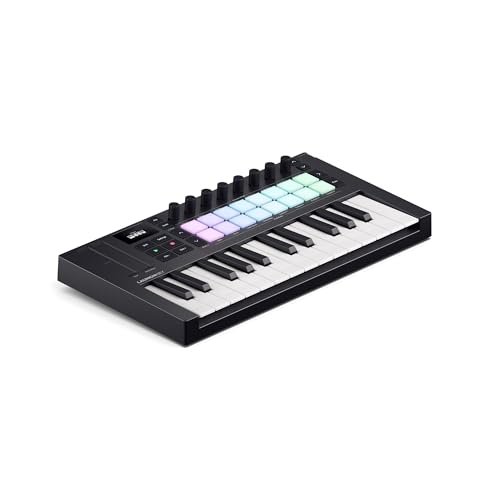
Novation Launchkey Mini 25 MK4 MIDI Controller
With 25 mini synth-action keys and 16 FSR pads with polyphonic aftertouch, this compact controller suits producers who want a portable Ableton workflow without a full-size keybed. Scale, Chord, and Arpeggiator modes plus broad DAW integration make it useful for sketching melodies, launching clips, and triggering chords quickly.
Pros
- 25 mini synth-action keys and 16 FSR pads provide a compact production surface.
- Polyphonic aftertouch pads support expressive drumming, clip launching, and chord triggering.
- Scale, Chord, and Arpeggiator modes help generate ideas and reduce wrong notes.
- Works with major DAWs and Native Kontrol Standard software.
- Includes bundled software, sounds, and lessons for new producers.
Cons
- Mini keys may feel cramped for players used to full-size piano keys.
- The 25-key span limits complex chord or melody playing.
- No full-size keybed is included for serious piano-style performance.
M-Audio Oxygen Pro 49 USB MIDI Keyboard
This 49-key USB MIDI controller is built around tactile DAW and virtual instrument control, with velocity-sensitive semi-weighted keys, aftertouch, and assignable zones. It suits producers who need direct access to plugins, drum pads, knobs, and faders, especially in Native Instruments NKS workflows.
Pros
- 49 velocity-sensitive, semi-weighted keys with aftertouch support expressive MIDI input.
- 16 RGB backlit pads provide dedicated beat, clip launching, and soundboard triggering controls.
- 8 assignable knobs and 9 assignable faders offer tactile control for virtual instruments, effect plugins, and DAW functions.
- Native Kontrol Standard integration connects the keyboard to Native Instruments presets and sound libraries.
- Bundled DAW recording software and selectable Komplete 15 Select bundle options add production tools.
Cons
- The 49-key span may limit extended keyboard parts or split-keyboard playing.
- Semi-weighted keys may not provide the feel of a fully weighted piano action.
- NKS advantages are tied to Native Instruments software, so other setups may see less integration.
Akai MPK Mini MK3 25 Key MIDI Controller
For compact studio setups, Akai's MPK Mini MK3 combines 25 velocity-sensitive mini keys, 8 backlit MPC-style pads, 8 assignable knobs, and a 4-way thumbstick in a USB-powered unit. Native Kontrol Standard support and included software bundles make it useful for beat programming, virtual instrument control, and small home-studio workflows.
Pros
- Compact USB powered design fits small desks and travel setups
- 25 velocity-sensitive mini keys support basic keyboard and synth control
- 8 backlit MPC-style pads include Note Repeat and Full Level for drum programming
- 8 assignable knobs and a 4-way thumbstick add in-depth control for plugins and modulation
- NKS support and bundled software help connect to compatible instruments
Cons
- The 25 mini keys can feel cramped for users who need a full-size playing surface
- USB power means it needs a connected computer or compatible power source to operate
- Eight pads may be limiting for producers who want more simultaneous sample or drum triggers
Arturia KeyLab Essential mk3 49-Key MIDI
For producers who want compact direct control, Arturia's 49-key KeyLab Essential mk3 pairs velocity-sensitive and pressure-sensitive RGB pads with Scale, Chord, and Arpeggiator modes. Its bundled software, 2,000 presets, and DAW scripts suit beginners and experienced users working in Ableton Live, Logic Pro X, or FL Studio.
Pros
- Scale, Chord, and Arpeggiator modes help with composition, songwriting, and beat-making.
- Velocity-sensitive and pressure-sensitive RGB pads, a contextual button, and a 2.5-inch LCD provide clear feedback.
- Custom DAW integration includes scripts for Ableton Live, Logic Pro X, and FL Studio.
- The bundled software includes 2,000 presets, two piano instruments, Loopcloud, and Melodics.
Cons
- The 49-key layout limits range for players who need more than a compact controller offers.
How We Picked
We compared 9 controllers by analyzing specifications, key features, and bundled software offerings from leading brands. Our goal was to create a transparent list catering to different needs and budgets, focusing on objective criteria rather than subjective testing.
- Keybed & Action: We evaluated key count (25, 49, 61, 88) and action type (synth, semi-weighted, mini).
- Control Surface: The availability and quality of pads, knobs, faders, and wheels for tactile control.
- Software Integration: Compatibility with major DAWs and the value of included software suites.
- Connectivity & Power: USB bus-powered operation and compatibility with computers and mobile devices.
- Build & Design: Form factor and layout suitability for studio desks and mobile setups.
Buying Guide: Making Sense of Best Midi Keyboards
Key Count and Action Type
The number of keys determines your playing range. A 25-key controller like the Arturia MiniLab 3 Universal MIDI Controller is highly portable for melodies and basslines, while 49 or 61 keys are better for two-handed playing and full compositions. Key action—synth-action, semi-weighted, or mini—affects the feel. Synth-action keys are fast and light for synth leads, while semi-weighted keys offer more resistance, mimicking an acoustic piano.
Control Surface and DAW Integration
Look for pads, knobs, and faders that map to your software. Pads are essential for finger drumming and clip launching. Knobs and faders provide hands-on control for mixing and synth parameters. Deep DAW integration, like the custom scripts in the Arturia KeyLab Essential mk3 USB MIDI Controller, can streamline your workflow by giving you transport control and parameter mapping without manual setup.
Bundled Software and Value
Most controllers include a software suite, which can represent significant value. Common inclusions are DAWs like Ableton Live Lite, virtual instruments, and sample libraries. Consider if the bundled software matches your needs or if you’ll rely on your existing plugins. For more on setting up a complete music production environment, check out our guide on the best electric guitars.
Quick Checklist
- Does the key count (25, 49, 61, 88) suit my playing style and space?
- Is the key action (synth, semi-weighted, mini) comfortable for my technique?
- Are there enough pads, knobs, and faders for my intended use?
- Is the controller compatible with my primary DAW and computer/device?
- Does the bundled software add value or fill a gap in my toolkit?
Related reading: Learn about other essential audio gear in our audio category.
FAQs
What is the best midi keyboards in 2026?
The “best” depends on your primary need. For a balanced, full-featured 49-key workstation, the M-AUDIO Keystation 49 MK3 is a top contender. It offers excellent value and essential controls for most producers.
How many keys do I need on a MIDI keyboard?
For portability and simple melodies, 25 keys suffice. For two-handed playing and more complex parts, 49 or 61 keys are ideal. If you’re a pianist needing the full range, an 88-key model like the M-AUDIO Keystation 88 MK3 USB MIDI Controller is necessary. Consider your desk space and mobility needs.
Do I need special drivers to use a USB MIDI controller?
Most modern USB MIDI controllers are class-compliant, meaning they work plug-and-play with macOS, Windows, and often iOS (with an adapter) without installing drivers. Always check the manufacturer’s specifications for your specific operating system. For more tech setup tips, visit our computers section.
What is the difference between synth-action and semi-weighted keys?
Synth-action keys are lightweight and spring-loaded, allowing for fast playing ideal for synth leads and arpeggios. Semi-weighted keys have a slightly heavier feel with more resistance, providing a touch more expression and a feel closer to an acoustic piano.
Can I use a MIDI controller with my iPad or iPhone?
Yes, many USB bus-powered controllers are compatible with iOS devices using Apple’s Lightning to USB Camera Adapter or a USB-C to USB adapter for newer iPads. Verify the controller’s iOS compatibility before purchasing.
What should I do if my DAW doesn’t recognize my new controller?
First, try a different USB cable and port. Then, check your DAW’s MIDI preferences to ensure the controller is selected as an input device. You may need to install specific driver software from the manufacturer’s website for advanced features. For more troubleshooting ideas, explore our musical instruments hub.
Final Thoughts
Our shortlist highlights three excellent controllers for distinct users. The M-AUDIO Keystation 49 MK3 is the best fit for most, offering a solid 49-key foundation with essential transport controls. The Novation Launchkey 61 MK4 excels for producers who rely heavily on pad workflows and deep DAW integration. Finally, the Akai Professional MPK Mini MK3 is the champion for compact, portable beat-making with its iconic MPC-style pads. Whichever you choose, ensure it aligns with your primary creative workflow. Once your controller arrives, take time to map its knobs and pads to your favorite software instruments and effects to unlock its full potential. For further inspiration on building your home studio, check out our guide to premium guitars.
About the author
Editor, Fashion & Accessories. Chloe covers everyday fashion, bags, watches and accessories. She compares materials, construction, sizing guidance and care requirements, and focuses on value over trends.