Best Fuzz Pedals 2026
A great fuzz pedal can define your guitar's core tone. We tested 9 leading models from brands like Behringer, Jim Dunlop, Zvex and more in November 2026 to find the ones that deliver.
 By Mei Tanaka
Updated November 19, 2026
Finding the right fuzz pedal can be a sonic minefield. You’re after that legendary, saturated tone, but end up with a muddy mess that gets lost in the mix, lacks note definition, or just doesn’t play nice with your other pedals. The core decisions boil down to the type of fuzz circuit (silicon vs. germanium), the available tonal controls for shaping, and how well it integrates into your existing pedalboard setup.

Our top recommendation for most players seeking classic, high-gain fuzz is the Electro-Harmonix Op Amp Big Muff Pi Fuzz Pedal. For those on a tight budget who still demand versatility, the Behringer Super Fuzz Sf300 3-Mode Fuzz Distortion is an outstanding value. For more insights into guitar gear, explore our Musical Instruments category.
The 3 Best Fuzz Pedals on Our Shortlist (November 2026)
- Best for: Classic high-gain fuzz tones
- Circuit: Op-Amp Big Muff
- Switching: True bypass
- Controls: Tone, Sustain, Volume

- Best for: Experimental sound sculpting
- Modes: 5 distinct fuzz states
- Clipping: Silicon & Germanium
- Controls: Bias, Tone, Volume

- Best for: Budget-friendly versatility
- Modes: Fuzz 1, Fuzz 2, Boost
- Power: 9V battery/PSU
- Controls: Gain, EQ, Level
This post may contain affiliate links. As an Amazon Associate we earn from qualifying purchases.
Quick Comparison
| Award | Product | TDB Score About LAT ScoreThe TDB Score is our own rating from 0 to 10, based on performance, design and build, ease of use, and value. It reflects independent research and is never influenced by manufacturers, retailers, or affiliate commissions. How we score | Price | |
|---|---|---|---|---|
| Best Overall |
Electro-Harmonix Op Amp Big Muff Pi Fuzz Pedal
|
9.1/10 | $96.20 | Buy |
| Best Budget |
Behringer Super Fuzz SF300 3-Mode Pedal
|
8.8/10 | $28.90 | Buy |
| Best Value |
 MXR M296 Classic 108 Fuzz Mini |
8.6/10 | $125.99 | Buy |
| Best Premium |
 ZVEX Fuzz Factory Vexter Germanium Fuzz Pedal |
8.6/10 | $229.00 | Buy |
| Top Rated |
 JHS 3 Series Fuzz 9V Pedal |
8.4/10 | $74.25 | Buy |
| Also Great |
 Electro-Harmonix Ram's Head Big Muff Pi Fuzz Pedal |
8.4/10 | $114.30 | Buy |
| Also Great |
 Dunlop FFM2 Germanium Fuzz Face Mini Pedal |
8.4/10 | $139.99 | Buy |
| Also Great |
 BOSS FZ-1w FUZZ Distortion Pedal |
7.8/10 | $186.66 | Buy |
| Also Great |
Walrus Audio Eons Five-State Fuzz Pedal
|
7.8/10 | $249.99 | Buy |
Electro-Harmonix Op Amp Big Muff Pi Fuzz Pedal
Electro-Harmonix recreates the late 1970s Op Amp Big Muff Pi as a compact fuzz pedal with Tone, Sustain, and Volume controls plus a Tone Bypass switch. True bypass and a die-cast enclosure make it pedalboard friendly for players chasing the classic Big Muff tone.
Pros
- Re-creation of the iconic late 1970s Op Amp Big Muff Pi sound
- Tone, Sustain, and Volume controls plus a Tone Bypass switch
- True bypass switching helps preserve signal integrity when bypassed
- Rugged, compact die-cast package is pedalboard friendly
Cons
- Focused on a classic Big Muff fuzz character rather than multiple pedal types
- Simple control set may offer fewer shaping options than more complex pedals
Behringer Super Fuzz SF300 3-Mode Pedal
For players chasing vintage fuzz textures, the Behringer Super Fuzz SF300 offers three modes covering classic fuzz, grunge, and gain boost. Gain, two-band EQ, and Level controls keep shaping straightforward, while a blue LED reports effect status and battery level. It runs on a 9 V battery or the separately sold BEHRINGER PSU-SB.
Pros
- Recreates classic 1960s and 1970s fuzz tones
- Offers three modes: classic fuzz, grunge, and gain boost
- Includes dedicated Gain, 2-band EQ, and Level controls
- Blue LED indicates effect on/off and battery check
Cons
- BEHRINGER PSU-SB power supply is not included
MXR M296 Classic 108 Fuzz Mini
A compact fuzz pedal that packs the Classic 108 tone into MXR's mini housing. The two-knob layout keeps controls simple, while the buffer switch helps it interact better with wah pedals. It suits players who want a small board-friendly fuzz with vintage character.
Pros
- Compact mini housing saves pedalboard space
- Classic 108 vintage fuzz tone in a smaller package
- Two-knob interface keeps control simple
- Buffer switch improves interaction with wah pedals
Cons
- Two-knob layout may feel limited for players who want deeper tone shaping
ZVEX Fuzz Factory Vexter Germanium Fuzz Pedal
ZVEX built the Fuzz Factory Vexter around two new old stock 1960s germanium transistors, giving it a distinctive fuzz character. The Volume, Gate, Compress, Drive, and Stability controls support a wide range of tones. Its hand-polished aluminum chassis and 3.25 by 3.25 by 5.5 inch size suit guitarists who want a sturdy, expressive fuzz pedal.
Pros
- Uses two new old stock 1960s germanium transistors
- Five controls, Volume, Gate, Compress, Drive, and Stability, support tone shaping
- Hand-silkscreened, hand-polished aluminum chassis
JHS 3 Series Fuzz 9V Pedal
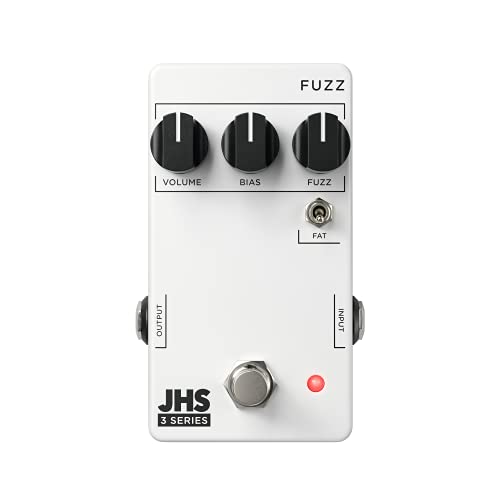
Built in Kansas City, the JHS Pedals 3 Series Fuzz pairs vintage fuzz character with modern clarity. Its Bias control, full sweep Fuzz knob, and Fat toggle make it a good fit for players who want gated sputter, distortion, or thicker low end in one pedal.
Pros
- Made in Kansas City, USA
- Bias control can create more gated fuzz tones
- Fuzz knob stays useful across the full sweep for fuzz, distortion, and overdrive flavors
- Fat toggle adds bass boost for a fatter sound
- Low 9 mA power draw helps with pedalboard power supply
Cons
- Uses 9V DC negative center power, so the supply must match that polarity
Electro-Harmonix Ram's Head Big Muff Pi Fuzz Pedal
This pedal is a faithful reproduction of the coveted 1973 Ram's Head circuit, delivering the iconic fuzz tone heard on countless classic recordings. It offers true bypass switching and a vintage aesthetic, making it a straightforward choice for players seeking that legendary sound.
Pros
- Faithful reproduction of the classic 1973 Ram's Head circuit
- True bypass switching preserves your guitar's natural tone when the effect is off
- Vintage look and graphics for classic appeal
- Comes with a 9V battery
Dunlop FFM2 Germanium Fuzz Face Mini Pedal
This miniaturized version of the classic 1960s Fuzz Face delivers the iconic, warm fuzz tones in a compact format ideal for crowded pedalboards. It's based on original designs with slightly mismatched germanium transistors for that vintage character.
Pros
- Compact, pedalboard-friendly housing saves space
- Reproduces legendary vintage Fuzz Face tones
- Includes modern conveniences like a status LED and AC power jack
Cons
- No built-in battery, requires separate purchase
BOSS FZ-1w FUZZ Distortion Pedal
This premium Waza Craft pedal is an all-analog fuzz designed to deliver both classic vintage tones and modern reliability. It offers extended tonal range through its dual-mode operation, making it a versatile choice for guitarists seeking the iconic BOSS fuzz experience.
Pros
- All-analog circuit for authentic warmth and character
- Dual Vintage and Modern modes for tonal versatility
- Premium Waza Craft build quality and components
- Extended range controls for detailed sound shaping
Walrus Audio Eons Five-State Fuzz Pedal
This versatile fuzz pedal offers five distinct clipping modes, from smooth silicon to angry hard clipping. It's a strong choice for players seeking a single unit capable of generating a wide spectrum of classic and modern fuzz textures.
Pros
- Five unique clipping modes provide extensive tonal variety
- Includes both silicon and germanium clipping for classic fuzz sounds
- Offers modes ranging from compressed and smooth to dynamic and loud
How We Picked
We compiled this list by analyzing specifications, manufacturer data, and aggregated user feedback to identify the most noteworthy fuzz pedals available. Our goal was to provide a transparent, objective overview across a range of prices and tonal characteristics. We focused on key criteria that matter most to guitarists:
- Circuit Type & Character: The foundational silicon or germanium transistor design that defines the pedal’s core sound.
- Tonal Control & Versatility: The range of sounds achievable via tone, gain, and other shaping controls.
- Build Quality & Durability: The robustness of the enclosure and components for pedalboard use.
- Pedalboard Compatibility: Features like true bypass switching, power requirements, and physical size.
- User Feedback & Reputation: Consistency in delivering the promised iconic tones.
Buying Guide: Making Sense of Best Fuzz Pedals
Silicon vs. Germanium: Choosing Your Fuzz Flavor
The heart of any fuzz pedal is its transistors. Silicon-based circuits, like those in many Big Muff-style pedals, tend to be louder, more aggressive, and stable across temperature changes. Germanium transistors, as found in classic Fuzz Face circuits, offer a warmer, slightly gated, and more vintage-articulate breakup that can be touch-sensitive. Your choice here sets the foundational character of your distortion.
Control Set: Shaping Your Sonic Mayhem
Don’t settle for a one-trick pony. Look beyond just volume and gain (or fuzz) knobs. A dedicated tone control is essential for cutting through a band mix or reigning in bass. Some advanced pedals, like the ZVEX Effects Fuzz Factory Vexter Series Fuzz, offer unique parameters like Gate and Stability for velcro-like gating and oscillation effects, opening up experimental possibilities.
Pedalboard Practicalities
Consider how the pedal will live on your board. True bypass switching preserves your dry tone when the pedal is off, while buffered bypass can prevent high-end loss in long signal chains. Check the power requirements; most use standard 9V DC, but some vintage-style circuits may be battery-only or have specific current draws. Physical size matters too—compact pedals like the MXR® Classic 108 Fuzz Mini save precious real estate. For more on building a complete setup, see our guide on the best electric guitars.
Quick Checklist
- Have I decided on a silicon or germanium transistor character for my core sound?
- Does the control set (Tone, Gain, Volume at minimum) offer enough shaping for my needs?
- Is the switching true bypass or buffered, and how will it interact with my other pedals?
- Does the pedal’s physical size and power supply (9V DC/battery) fit my pedalboard plan?
- Does the pedal’s reputation and user feedback align with the iconic tone I’m chasing?
Related reading: Best Fuzz Pedals 2026
FAQs
What is the best fuzz pedals in 2026?
The “best” depends entirely on your needs. For iconic, high-sustain fuzz, the Electro-Harmonix Big Muff variants are benchmarks. For vintage warmth and touch response, germanium-based pedals like the Dunlop Fuzz Face are legendary.
Do fuzz pedals work well with other distortion or overdrive pedals?
They can, but order matters. Placing a fuzz pedal first in your chain, directly after your guitar, often yields the best response, especially for germanium fuzzes. Stacking a boost or overdrive after a fuzz can add more gain and compression. Experimentation is key.
Why does my fuzz pedal sound thin or weak in a band mix?
Many classic fuzz circuits scoop midrange frequencies. Using the pedal’s tone control to add mids or placing an EQ pedal after it can help you cut through. The JHS Pedals 3 Series Fuzz includes a Fat toggle for a bass boost to combat this issue. For full-range sound considerations, check out our Audio category.
What’s the difference between fuzz, distortion, and overdrive?
Overdrive simulates a tube amp being pushed gently into breakup. Distortion provides more aggressive, compressed clipping. Fuzz is an extreme form of distortion created by heavily clipping and squaring off the waveform, resulting in a buzzy, saturated sound synonymous with classic rock and psychedelia.
Are expensive fuzz pedals worth the money?
Higher-priced pedals often use premium components (like New Old Stock transistors), offer hand-built construction, or provide vastly expanded tonal possibilities through unique circuits. However, excellent-sounding budget options exist that faithfully recreate classic tones.
Do I need a special power supply for my fuzz pedal?
Most modern fuzz pedals use a standard 9V DC center-negative power supply. Always check the manual, as some vintage-style circuits are designed for battery power only to prevent noise. Using an isolated power supply can reduce hum. For more on powering your gear, our home theater receiver guide covers clean power principles.
Final Thoughts
Our shortlist highlights three distinct paths. The Electro-Harmonix Op Amp Big Muff Pi Fuzz Pedal is your go-to for its iconic, soaring sustain and classic high-gain fuzz tones, perfect for rock and shoegaze. The Walrus Audio Eons Five-State Fuzz Pedal caters to the sonic explorer with its five unique clipping modes, offering everything from traditional fuzz to angry, compressed distortion for maximum creative flexibility. The Behringer Super Fuzz Sf300 delivers remarkable value, packing three useful modes (including a great boost) into a budget-friendly package ideal for beginners or players wanting versatile fuzz on a dime. When your new pedal arrives, take time to explore its full range of settings at both bedroom and band volumes, and remember that its position in your effects chain will significantly alter its behavior. For further inspiration on crafting your perfect guitar tone, delve into our review of the best acoustic guitars for beginners.
About the author
Editor, Cameras. Mei covers mirrorless, compact and action cameras. She compares sensor size, autofocus, video specs, lens ecosystems and battery life, and says which kind of shooter each camera suits.