The 6 Best Synthesizers of 2026
The right synthesizer can define your sound, whether you're crafting electronic beats or composing cinematic scores. Our 2026 roundup cuts through the specs to spotlight the instruments that deliver exceptional tone and playability.
 By Carlos Ortega
Updated November 19, 2026
Choosing a synthesizer can be overwhelming. You’re likely struggling with balancing professional-grade sound quality against a budget, figuring out which features are essential for your music style, and navigating the confusing mix of analog, digital, and hybrid engines. The key decisions that matter most are the sound engine type, the keyboard’s playability and size, and the available creative tools like sequencers and effects.

We’ve analyzed the latest models to cut through the noise. For most musicians seeking a versatile, gig-ready instrument, the Roland JUNO-D6 Synthesizer, 61-Note Keyboard is our top recommendation. If your priority is exploring cutting-edge hybrid synthesis in a compact format, consider the Arturia MiniFreak 37 Key Polyphonic 6-Voice Hybrid. For more insights on musical gear, explore our Musical Instruments category.
The 3 Best Synthesizers on Our Shortlist (November 2026)
- Best for: Live stage performance
- Keys: 61 synth-action
- Engine: ZEN-Core
- Sounds: 3800+

- Best for: Analog sound purists
- Keys: 37 semi-weighted
- Engine: Pure analog
- Modulation: Dual bus

- Best for: Portable FM synthesis
- Keys: 37 mini
- Engine: 4-operator FM
- Feature: Built-in looper
This post may contain affiliate links. As an Amazon Associate we earn from qualifying purchases.
Quick Comparison
| Award | Product | TDB Score About LAT ScoreThe TDB Score is our own rating from 0 to 10, based on performance, design and build, ease of use, and value. It reflects independent research and is never influenced by manufacturers, retailers, or affiliate commissions. How we score | Price | |
|---|---|---|---|---|
| Best Overall |
Roland JUNO-D6 61-Note Synthesizer
|
9.2/10 | $865.95 | Buy |
| Best Value |
 Arturia MiniFreak 37-Key Hybrid Synth |
9.1/10 | $599.00 | Buy |
| Best Premium |
MOOG Subsequent 37 37 Key Analog Synth
|
8.9/10 | $1,899.00 | Buy |
| Top Rated |
 Roland JD-XI Analog/Digital Crossover Synthesizer |
8.6/10 | $739.99 | Buy |
| Best Budget |
Yamaha REFACE DX Portable FM Synthesizer
|
8.4/10 | $449.99 | Buy |
| Also Great |
 Korg microKORG 37-Key Synthesizer |
8.3/10 | $565.00 | Buy |
Roland JUNO-D6 61-Note Synthesizer
Roland's JUNO-D6 packs a ZEN-Core engine with more than 3,800 sounds into a 61-key, 12.79-pound keyboard built for stage and studio use. USB-C audio/MIDI support and mobile battery power make it easy to pair with computers or live rigs, while the eight-track sequencer and WAV sample import add practical tools for arranging and customization.
Pros
- Compact 61-note synth-action keyboard weighs 12.79 pounds, supporting portable gig and studio use
- ZEN-Core engine provides over 3,800 ready-to-play sounds, including acoustic piano, electric piano, organ, and synth choices
- USB-C audio/MIDI interface and mobile battery power support help connect to computers and mobile setups
- Eight-track sequencer and direct WAV sample import allow arranging and custom sound creation on the keyboard
- Roland Cloud Sound Packs and Wave Expansions let owners grow the library beyond onboard sounds
Cons
- 61-note synth-action keys may not satisfy players who want a full-size, weighted piano feel
- Expanded sounds and waves depend on Roland Cloud content, so library growth is tied to that ecosystem
Arturia MiniFreak 37-Key Hybrid Synth
This 37-key hybrid synthesizer pairs six voices with a compact keyboard layout, targeting electronic musicians who need a portable instrument for flexible sound design. It fits producers and performers who value immediate key control and a focused synth workflow.
Pros
- Compact 37-key layout reduces desk space needs
- Six-voice polyphony supports chords, bass lines, and layered parts
- Hybrid design is positioned for flexible sound exploration
- Keyboard format makes it practical for live playing and patch editing
Cons
- 37 keys may feel limited for players who need a wider keyboard range
- Six voices may not be enough for very dense polyphonic passages
MOOG Subsequent 37 37 Key Analog Synth
Built around a 37 key semi weighted paraphonic keybed, this analog synthesizer offers deep modulation routing and broad studio connectivity. The included editor software and many physical controls suit producers who want tactile sound design and integration with DAWs or CV/GATE setups. Its weight and dense panel make it better suited to fixed studio use than portable performance.
Pros
- 37 key semi weighted keybed with velocity and aftertouch
- Two modulation buses with LFOs and programmable routing
- MIDI, USB, audio, headphone, and CV/GATE connections
- Included editor and librarian software for Windows and Mac
- Multiple analog sound sources, including sub oscillator and noise generator
Cons
- 22 pound weight makes portable use less practical
- Dense control panel may require time to learn
- 2 note paraphonic design is not full polyphony
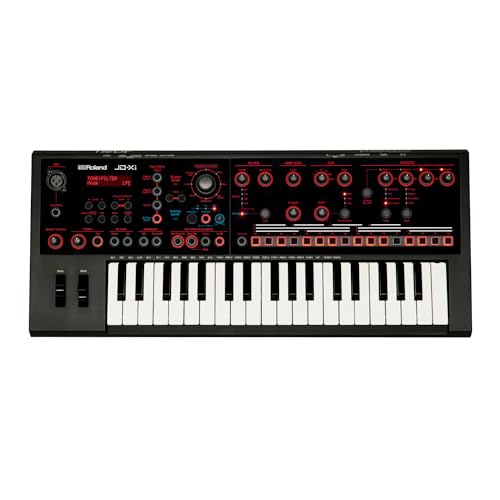
Roland JD-XI Analog/Digital Crossover Synthesizer
This Roland JD-XI is a compact synth that blends analog warmth with digital versatility, making it a creative powerhouse. Its integrated pattern sequencer and included microphone for vocoder effects encourage instant experimentation. It's a solid choice for producers and performers looking for a portable, all-in-one sound design tool.
Pros
- Combines authentic analog synth engine with two versatile digital synth sections.
- Includes a gooseneck microphone for vocoder and AutoPitch effects out of the box.
- Features a four-track pattern sequencer and onboard drum sounds for song sketching.
- Compact and lightweight design (37 keys, 4.14 lbs) enhances portability.
- Allows for rich sound processing with four simultaneous effects.
Cons
- The 37-key keyboard may be limiting for players requiring a broader range.
Yamaha REFACE DX Portable FM Synthesizer
This portable synthesizer brings classic 4-operator FM synthesis to a compact, battery-powered package. It's ideal for musicians seeking authentic vintage digital sounds and on-the-go music creation, thanks to its built-in speakers and looper.
Pros
- Authentic 4-operator FM sound engine for dynamic, expressive tones.
- Highly portable with built-in speakers and a battery-powered design.
- Includes a 32-voice memory and an integrated phrase looper for creative workflows.
- High-quality mini keyboard offers a premium feel for its size.
Cons
- The 37-mini-key keyboard may be limiting for complex playing.
- Its compact size and lightweight build might feel less substantial to some users.
Korg microKORG 37-Key Synthesizer
A compact analog modeling synthesizer, the Korg microKORG combines 37 full-size keys, a built-in vocoder, and a mini mic for vocal transformation. Its 4-voice polyphony, 6-step arpeggiator, MIDI connectivity, and dedicated controls support portable live use and home studio sound design.
Pros
- 37 full-size keys provide an expressive playing experience
- Built-in vocoder and mini mic enable vocal effects and robotic voice transformations
- 4-voice polyphony supports layered sounds
- MIDI connectivity integrates with other music gear
- Built-in speaker allows immediate audio playback for quick practice
Cons
- 4-voice polyphony may limit dense layered sound design
- 37-key span may be restrictive for full keyboard players
How We Picked
Our selection process for the top Best synthesizers of 2026 was based on a detailed analysis of specifications, feature sets, and the intended use cases for each instrument. We compared the core attributes that define a synthesizer’s capability and value to ensure our list serves diverse needs, from studio production to live performance.
- Sound Engine & Tonal Range: The type (Analog, Digital, FM, Hybrid) and the breadth of onboard sounds.
- Keyboard & Playability: Key count, keybed type (synth-action, semi-weighted), and portability.
- Creative & Performance Tools: Built-in sequencers, arpeggiators, vocoders, and effects processors.
- Connectivity & Expansion: USB/MIDI capabilities, audio I/O, and potential for sound library expansion.
- Workflow & Usability: Intuitive layout, preset management, and real-time control options.
Buying Guide: Making Sense of Best Synthesizers
Sound Engine: The Heart of Your Sound
The engine defines your sonic palette. Analog synthesizers offer warm, organic tones prized for bass and leads. Digital and FM engines provide crisp, complex sounds ideal for pads, keys, and classic electronic tones. Hybrid models, like the Arturia MiniFreak 37 Key Polyphonic 6-Voice Hybrid, blend both worlds. Consider the genres you play; a versatile all-rounder might suit you best, or you might need a specialist engine.
Keyboard Feel and Size
Key count and action directly impact playability. A full 61-key keyboard allows for broader range playing, while 37 keys offer a compact, portable solution. Synth-action keys are light and fast, perfect for rapid passages, while semi-weighted keys provide a more piano-like, expressive feel. Your available space and whether you’ll transport the instrument frequently are crucial deciding factors.
Built-in Creative Features
Look beyond the basic oscillators and filters. Features like multi-track sequencers, arpeggiators, and vocoders can spark new ideas and enhance live performances. A built-in looper, as seen on the Yamaha REFACE DX Portable FM Synthesizer, is invaluable for sketching ideas. Effects like reverb, delay, and chorus are essential for finishing your sound without external gear. For more on audio gear features, see our guide on Best Synthesizers 2026: Reviews & Comparison.
Quick Checklist
- Have I identified the primary sound engine type (Analog/Digital/FM/Hybrid) I need?
- Does the keyboard size (37 vs. 61 keys) and action fit my playing style and space?
- Are the essential creative tools (sequencer, arpeggiator, effects) present?
- Does it have the necessary connectivity (USB, MIDI, audio outputs) for my setup?
- Is the interface intuitive for sound design and live parameter tweaking?
Related reading: The 6 Best Synthesizers of 2026.
FAQs
What is the best synthesizers in 2026?
The “best” depends entirely on your needs. For most players seeking a professional, all-in-one workstation for live use, the Roland JUNO-D6 Synthesizer, 61-Note Keyboard is an excellent choice due to its vast sound library and gig-ready design.
How many keys do I need on a synthesizer?
For two-handed playing and broad melodic range, 61 keys is ideal. For portability, bass lines, lead lines, or pairing with a master keyboard, 37 keys is sufficient and saves space.
What’s the difference between analog and digital synthesizers?
Analog synths generate sound using electronic circuits, often resulting in rich, warm, and sometimes unpredictable tones. Digital synths use processors to generate or model sounds, allowing for immense versatility, crystal-clear digital tones, and complex soundscapes like those from FM synthesis.
Do I need a computer to use these synthesizers?
No, all models on our list are fully functional standalone instruments. However, USB connectivity allows for easy recording, MIDI control, and in some cases, sound expansion via companion software, enhancing their capabilities. Learn more about tech integration in our Computers category.
What is a vocoder and do I need one?
A vocoder combines a microphone input (your voice) with the synth’s sound generator to create robotic or harmonized vocal effects. It’s essential for specific electronic music styles but not a core feature for all players. The Korg microKORG Compact Analog Modeling Synthesizer includes a popular vocoder.
Is a built-in sequencer important?
For songwriting, practice, or live performance without a laptop, a built-in sequencer is incredibly valuable. It lets you record and play back chord progressions or melodies, freeing you to play other parts or tweak sounds in real-time. For deeper dives into audio technology, check out our Audio section.
Final Thoughts
Our analysis highlights three standout instruments tailored for different musicians. The Roland JUNO-D6 Synthesizer, 61-Note Keyboard is best for live stage performance, offering reliability and a massive sound library. The MOOG Subsequent 37 Paraphonic Analog Synthesizer serves analog sound purists with its deep, hands-on control and iconic tone. For those needing portable FM synthesis, the Yamaha REFACE DX Portable FM Synthesizer combines classic digital sounds with modern portability and a built-in looper. Whichever you choose, ensure your space has proper power and consider investing in a sturdy stand or case. Explore more instrument reviews in our guide on The 6 Best Synthesizers of 2026.
About the author
Editor, TVs & Home Theater. Carlos covers TVs, projectors and home theater gear. He explains panel types, brightness, refresh rates, HDR formats and smart platforms, and compares picture quality against price.