Best Shortwave Radios for Emergency Use 2026: Top 5 Picks
When the grid goes down in 2026, a shortwave radio gives you weather updates, emergency alerts, and outside news. The 5 top-rated models from Kaito, TecsunUSA, EMGYKIT stand out for battery life, NOAA alerts, and portability.
 By Leo Martinez
Updated November 6, 2026
When a storm knocks out power or a crisis disrupts normal communication, finding a reliable source of information becomes critical. The right shortwave radio for emergency use must deliver clear reception of distant signals, operate independently of the grid for extended periods, and provide access to vital weather alerts and news broadcasts. Your decisions will hinge on battery life and power options, the clarity and range of reception, and the inclusion of dedicated emergency alert systems.

After analyzing specs and user feedback, our top pick for most users seeking comprehensive coverage is the Tecsun PL880 Portable Digital PLL Dual Conversion. For those prioritizing targeted, local emergency alerts above all else, the NOAA Weather Alert Radio with S.A.M.E Setup is an excellent specialized choice. For more on essential audio gear, explore our Audio category.
The 3 Best Shortwave Radios For Emergency Use on Our Shortlist (November 2026)
- Best for: Comprehensive world band coverage
- Reception: PLL Dual Conversion
- SSB: Yes
- Bandwidth Filters: 9 total

- Best for: Off-grid power independence
- Power Sources: Solar/Hand Crank/USB
- Flashlight: Yes
- Weather Alerts: NOAA

- Best for: Precise local emergency alerts
- Alert System: S.A.M.E. Technology
- Alert Modes: Voice/Siren/Light
- Coverage: 80+ emergencies
This post may contain affiliate links. As an Amazon Associate we earn from qualifying purchases.
Quick Comparison
| Award | Product | TDB Score About LAT ScoreThe TDB Score is our own rating from 0 to 10, based on performance, design and build, ease of use, and value. It reflects independent research and is never influenced by manufacturers, retailers, or affiliate commissions. How we score | Price | |
|---|---|---|---|---|
| Best Overall |
EMGYKIT MD319 NOAA Weather Alert Radio with SAME
|
8.4/10 | $42.99 | Buy |
| Best Budget |
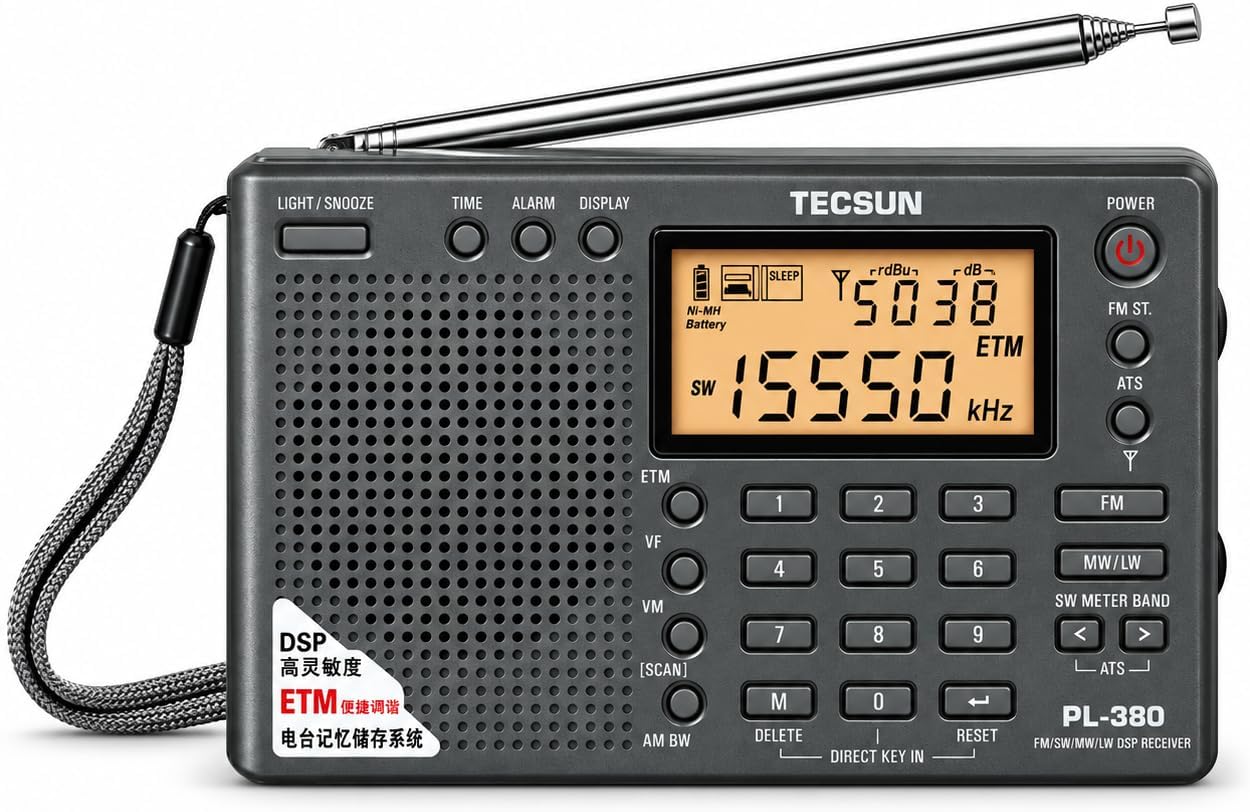 Kaito TECSUN PL-380 DSP Multi-Band Radio |
8.4/10 | $54.99 | Buy |
| Best Premium |
Tecsun PL880 Portable Digital AM/FM Shortwave
|
8.4/10 | $179.99 | Buy |
| Best Value |
 Tecsun PL330 Digital Worldband Radio with SSB |
8.3/10 | $84.99 | Buy |
| Top Rated |
Kaito Voyager Pro KA600 Digital Emergency Radio
|
8.1/10 | $94.99 | Buy |
EMGYKIT MD319 NOAA Weather Alert Radio with SAME
This EMGYKIT receiver uses NOAA's official broadcast network and S.A.M.E. technology to filter alerts geographically. It's a strong choice for targeted, fast emergency notifications thanks to its rapid activation, loud siren, and visual alerts.
Pros
- S.A.M.E. technology filters alerts by specific county codes to reduce irrelevant alarms.
- Fast activation time of 0.3 seconds once a relevant alert is received.
- Offers multiple alert modes: clear voice, 90+ dB siren, and silent visual strobes.
- Dual power (AC/battery) ensures operation during blackouts.
- Supports over 80 emergency alert types, from severe weather to civil emergencies.
Cons
- Requires initial setup with county code selection, though this is a one-time task.
Kaito TECSUN PL-380 DSP Multi-Band Radio
This DSP-equipped portable receiver covers a wide range of bands, from FM to shortwave, making it a versatile tool for travelers and radio enthusiasts. Its standout ETM function simplifies finding stations in new areas without overwriting your preset memories.
Pros
- Extensive multi-band coverage including FM, MW, SW, and LW
- Unique ETM (Easy Tuning Mode) for non-destructive station scanning
- Compact and portable design suitable for outdoor use
- Offers multiple tuning modes and 550 memory presets
- Includes useful features like a digital clock, sleep timer, and temperature display
Cons
- Powered by specific batteries, requiring a power source for extended use
- Interface and features may have a learning curve for casual users
Tecsun PL880 Portable Digital AM/FM Shortwave
This advanced portable receiver is for enthusiasts who demand serious DXing capabilities. It replaces the PL660 with superior sound, PLL dual conversion, and extensive coverage including AM, FM, LW, SW, and SSB. The high storage capacity and multiple bandwidth filters make it a detailed and powerful tool for global listening.
Pros
- PLL dual conversion with excellent sensitivity and selectivity for clear reception
- Comprehensive band coverage including SSB for amateur radio
- High-quality, distortion-free audio from a full-range speaker and dynamic amplifier
- Extensive memory for storing up to 3050 stations
- Includes useful features like an alarm clock, sleep timer, and LCD backlight
Cons
- Power source is a single AA battery, which may require frequent replacement for heavy use
- Plastic enclosure may feel less premium compared to some metal-body competitors
Tecsun PL330 Digital Worldband Radio with SSB
This compact digital receiver covers a vast spectrum from AM/FM to longwave, shortwave, and single side band, making it a versatile tool for global listeners and hobbyists. Its DSP technology and synchronous detection aim for clear reception, while features like 850 memory presets and a rechargeable battery enhance its portability for travel or emergency use.
Pros
- Extensive frequency coverage including SSB for specialized listening
- DSP and synchronous detection for improved reception clarity
- Portable and lightweight design with rechargeable battery
- Substantial 850 memory slots for station presets
- Includes alarm clock and sleep timer functions
Cons
- Speaker maximum output power is relatively low at 0.2 watts
- Primary enclosure material is plastic
Kaito Voyager Pro KA600 Digital Emergency Radio
This versatile emergency radio combines NOAA weather alerts with AM/FM/LW/SW bands and multiple power options. Its built-in flashlight, reading lamp, and phone charging capability make it a practical centerpiece for any preparedness kit.
Pros
- Multiple power sources including solar, hand crank, and rechargeable battery ensure operation during extended outages.
- Receives NOAA weather alerts for real-time severe weather updates.
- Includes practical emergency features like a bright flashlight and a phone charger.
- Compact, portable design suitable for camping and travel.
Cons
- Relies on AA batteries as a primary or backup power source.
- Plastic enclosure may not feel as durable as other materials.
How We Picked
To identify the best shortwave radios for emergency preparedness, we analyzed specifications, verified features against user manuals, and sifted through thousands of owner reviews to gauge real-world reliability and performance. Our goal was to highlight models that excel in critical areas for emergency scenarios.
- Reception & Band Coverage: Priority was given to radios with proven sensitivity across AM/FM/SW/LW bands, plus SSB for amateur radio.
- Power & Battery Life: We looked for multiple power sources (AC, battery, solar, hand crank) and long runtime on internal or backup batteries.
- Emergency Alert Features: Dedicated NOAA weather radio reception and alert systems like S.A.M.E. were key differentiators.
- Portability & Durability: Size, weight, and build quality were assessed for ease of transport and storage in a go-bag.
- Additional Functionality: Useful extras like built-in flashlights, charging ports, and clear displays were noted.
Buying Guide: Making Sense of Best Shortwave Radios For Emergency Use
1. Prioritize Signal Reception and Clarity
In an emergency, a faint or garbled signal is useless. Look for features that enhance reception: digital signal processing (DSP), PLL synthesized tuning, and single side band (SSB) capability. SSB is especially important for receiving clear amateur radio broadcasts, which are often a key source of information during widespread outages. Models with external antenna ports offer flexibility to boost weak signals.
Tip: For the best general-purpose reception that balances advanced features with user-friendliness, consider the Tecsun Digital PL330 AM/FM/LW/SW Worldband Radio. Its DSP technology and synchronous detection help pull in clear signals even in challenging conditions.
2. Assess Power Independence
Your radio is only as good as its power source when the grid fails. Evaluate the primary and backup power options. Standard battery operation (AA or rechargeable) is common, but for true resilience, look for models with integrated solar panels and hand cranks. These can keep you informed indefinitely, even if you run out of stored batteries. Check estimated runtimes on battery power alone.
Tip: If you anticipate extended off-grid scenarios, a radio like the Kaito Voyager Pro KA600, with its solar panel, hand crank, and USB charging, provides the ultimate in power flexibility. For insights into other essential preparedness gear, see our guide on the best gifts for new dads, which often includes practical items.
3. Understand Alert Systems
Not all emergency alerts are created equal. Basic NOAA weather radio reception is good, but S.A.M.E. (Specific Area Message Encoding) technology is better. It allows you to program your specific county codes, so the radio only sounds alerts for threats targeting your immediate area, filtering out irrelevant warnings. This prevents alert fatigue and ensures you only wake up for genuine local dangers.
Quick Checklist
- Does it cover AM/FM/SW/LW bands with SSB capability?
- What are the power sources (battery, solar, hand crank, AC)?
- Does it have dedicated NOAA weather alerts, preferably with S.A.M.E.?
- Is it portable and durable enough for your emergency kit?
- Are there useful extras (flashlight, phone charger, clear display)?
Related reading: For gear that enhances other aspects of home life, check out our picks for the best speaker cables.
FAQs
What is the best shortwave radios for emergency use in 2026?
For 2026, our top choice for most users is the Tecsun PL880 for its exceptional all-band reception and audio quality. However, the “best” depends on your primary need: maximum reception, dedicated local alerts, or complete off-grid power independence.
Do I need Single Side Band (SSB) on an emergency radio?
SSB is highly recommended for serious emergency preparedness. It allows you to listen to amateur (ham) radio operators and maritime communications, which often provide critical, real-time information during disasters when standard broadcast stations may be offline.
How important is a solar panel or hand crank?
They are crucial for long-term resilience. While battery-powered radios are common, their usefulness ends when the batteries die. A solar panel and hand crank ensure you can always generate power, making a radio like the TECSUN PL-380 DSP FM Stereo. MW. SW. LW. World—though it lacks these features—better suited for shorter-term, battery-managed scenarios. For more on versatile electronics, visit our Computers category.
What’s the difference between NOAA and S.A.M.E. alerts?
NOAA is the broadcast source (National Oceanic and Atmospheric Administration). S.A.M.E. is a filtering technology that uses geographic codes. A radio with only NOAA will alert for any broadcast in its range, while a S.A.M.E.-enabled radio only alerts for threats targeting your programmed location.
How do I maintain my emergency radio?
Store it in a cool, dry place. Periodically check and replace backup batteries (if removable), and test all functions, including the hand crank and solar panel, every few months. Keep the antenna extended during storage to avoid damage.
Can these radios charge other devices?
Some models, typically those with hand cranks and larger batteries, include a USB port to charge smartphones or other small USB devices. This is a valuable feature for keeping a communication device powered. Explore our Automotive section for other mobile power solutions.
Final Thoughts
Selecting the right shortwave radio for your emergency kit comes down to matching features to your most likely scenarios. The Tecsun PL880 Portable Digital PLL Dual Conversion stands out for users who want the most capable all-around receiver for global news and amateur radio. The Kaito Voyager Pro KA600 Digital Solar Dynamo Hand is the definitive choice for those needing indefinite, grid-independent power. Finally, the NOAA Weather Alert Radio with S.A.M.E Setup is unparalleled for anyone whose primary concern is hyper-local, automated alerts for immediate threats like tornadoes or flash floods. Whichever model you choose, integrate it into your overall preparedness plan. For more on creating a safe and functional home environment, consider our recommendations for the best soundbars for large rooms. Upon receiving your radio, immediately test all functions, program any S.A.M.E. codes, and familiarize yourself with the controls so you’re ready when every second counts.
About the author
Senior Editor, Audio & Headphones. Leo covers speakers, soundbars, headphones and earbuds. His guides compare sound signature, noise cancelling, battery life, codecs and comfort, and explain what each spec on the box means.